Hello, my dearest readers from all across the globe! This is Bibi, your friendly local guide living in South Korea, here once again to share the warm, vibrant, and cozy aspects of our daily life with all of you. Thank you so much for stepping into my little space today!
Lately, we have been having so much fun chatting about various Korean snacks, and I am absolutely thrilled to introduce some of my personal all-time favorites to you. So, which snack shall we dive into today? Well, I’ve decided we should talk about a beloved chocolate treat that I used to munch on all the time during my childhood—‘Kancho’!
Have you ever had the chance to walk inside a massive hypermarket or a cozy, small neighborhood grocery store in South Korea? If you step into the snack aisle of any Korean mart, you will instantly be greeted by towering shelves packed to the brim with a dazzling, almost overwhelming variety of treats. From savory potato chips and traditional biscuits to colorful, sweet jellies, the options are endless, and you might find yourself completely lost trying to choose just one.
Out of all those countless choices, today I want to introduce you to a legendary snack that practically every single person in Korea associates with fond, nostalgic childhood memories. It undisputedly holds the title for being the absolute “epitome of cuteness” among Korean chocolate snacks. Today, we will not only look at this adorable little biscuit but also dive into the fascinating cultural background and the unique history of the company hidden behind it. So, please stay tuned and read along until the very end!
Lotte Confectionery and Kancho: A Fascinating Tale of Two Countries
Before we fully immerse ourselves in the delightful characteristics of Kancho, it is highly valuable to talk about the company that created it: Lotte Confectionery. If you are someone who loves Korean pop culture, dramas, or cosmetics, the name ‘Lotte’ is likely very familiar to you. In South Korea, Lotte is a towering conglomerate that goes far beyond just manufacturing food. They operate world-class department stores, luxury hotels, a massive indoor theme park (Lotte World), and even the tallest building in the country, the Lotte World Tower.
However, there is an incredibly unique and complex historical fact hidden behind this mega-brand. While many international travelers naturally assume Lotte is a 100% homegrown South Korean company, it was actually first founded in Japan in 1948 by the late Korean businessman Shin Kyuk-ho. After achieving monumental success with chewing gum and confectionery products in Tokyo, Shin crossed the sea over to his homeland in 1967 to establish ‘Lotte Confectionery,’ kickstarting the brand’s legendary journey in South Korea.
Due to this distinctive cross-border history, the top governance of the company is still heavily tied to Lotte Holdings in Japan. As a result, a fascinating and sometimes heated public debate has existed within South Korean society for decades: “Is Lotte ultimately a Korean company or a Japanese company?” During periods of geopolitical tension between the two nations, Lotte products have occasionally faced consumer boycotts due to these complex sentiments. However, separate from corporate structures and political debates, there is an undeniable truth that Lotte Confectionery has shaped the taste buds of generations of Koreans, creating an irreplaceable catalog of national treats. Kancho is a beautiful byproduct of this historical and cultural exchange between the two countries. It has successfully woven itself into the emotional fabric of Korean society, standing proud as a beloved, sentimental “national snack” that transcends corporate borders.
The Peak of Cuteness: The Visual Joy of Bite-Sized Kancho
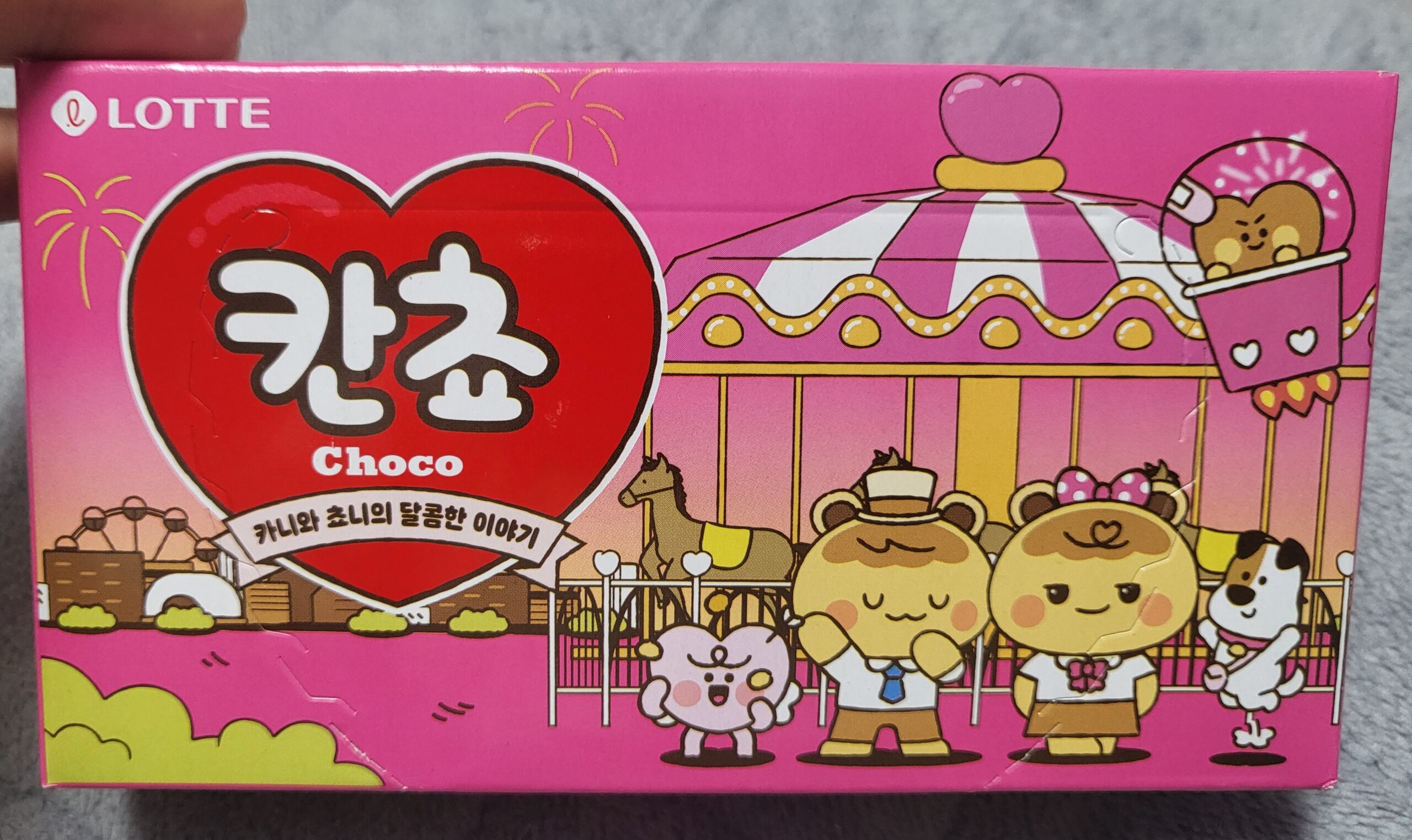
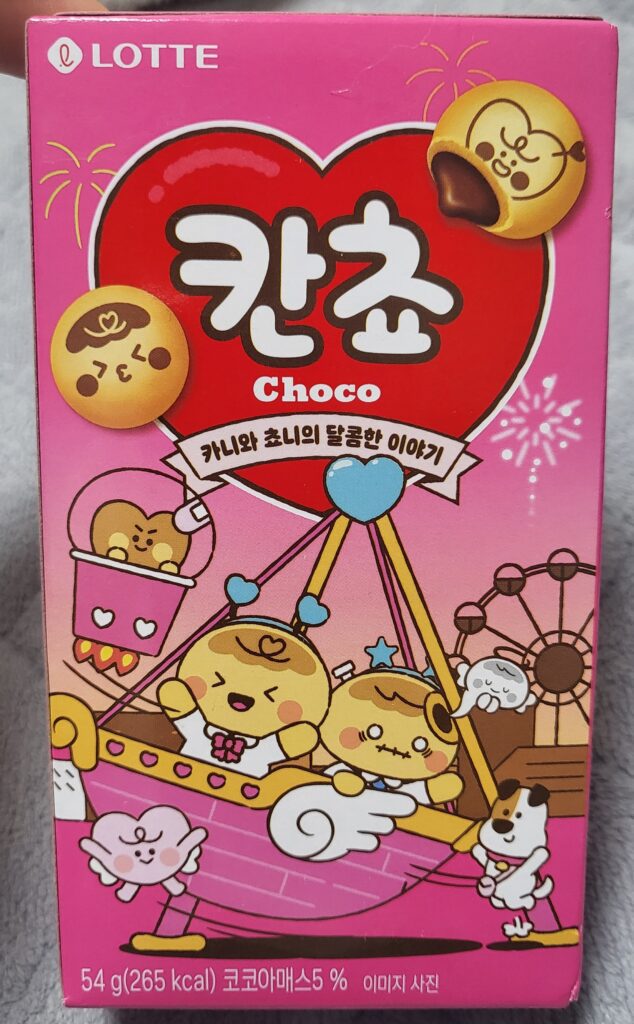
Now, let us get to the best part: falling completely in love with the irresistible charms of Kancho! While South Korea boasts an incredible variety of chocolate-filled biscuits, if I had to choose just one that represents the absolute peak of visual cuteness, I would select Kancho without a single moment of hesitation. When you are browsing the supermarket shelves, the very first thing that will capture your heart is Kancho’s bright, adorable pastel-pink box packaging. On the cover, you will find the snack’s signature mascot characters, ‘Kani’ and ‘Choni,’ flashing bright, cheerful smiles that instantly put you in a good mood.
When you carefully slide open the cardboard box and tear into the inner protective foil packaging, a wonderfully rich, buttery, and sweet milk chocolate aroma gently fills the air. Inside, you will discover a generous handful of small, perfectly round, bite-sized biscuits.
The absolute highlight of eating Kancho lies in the tiny, whimsical illustrations stamped onto the surface of every single cookie! No two biscuits are quite the same; you will find microscopic prints of rock-paper-scissors icons, cute animals, sports equipment, and various playful expressions. Because of this brilliant design, locals never just blindly shove a handful of Kancho into their mouths. Instead, it is a cultural ritual to pick them up one by one, look closely at the biscuit, and enjoy the visual surprise before taking a bite. From the lovely box to the round shapes and individual drawings, it is a multi-sensory experience that delights both your eyes and your palate simultaneously.
A Masterclass in Balanced Taste and a Nostalgic High School Trend
So, what exactly does this cute little biscuit taste like? To give you an honest, transparent review from a local’s perspective, the chocolate filling inside Kancho does not completely stuff the interior 100% to the brim. If you bite one in half, you might notice a small pockets of air inside. However, believe it or not, this precise ratio is the ultimate secret behind why Kancho has remained a bestseller for over forty years without ever going out of style!
Because the milk chocolate filling is portioned in a modest, balanced amount, it creates a breathtaking harmony with the crunchy, savory, and lightly salted biscuit shell. If a biscuit is absolutely overflowing with heavy chocolate fudge, it can quickly become cloyingly sweet, making your palate tired after just two or three pieces. Kancho, on the other hand, strikes the perfect golden ratio between the nuttiness of the baked dough and the mild sweetness of the chocolate, making it remarkably clean, light, and easy to snack on. This balanced profile makes it a universally loved treat, serving as a nostalgic after-school snack for children paired with a cold glass of milk, or a sophisticated, light dessert for adults alongside a hot cup of black coffee.
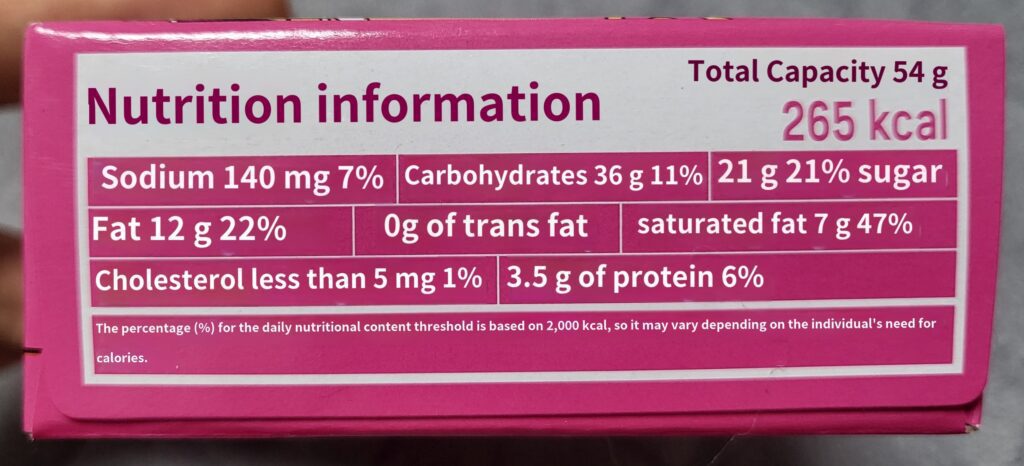
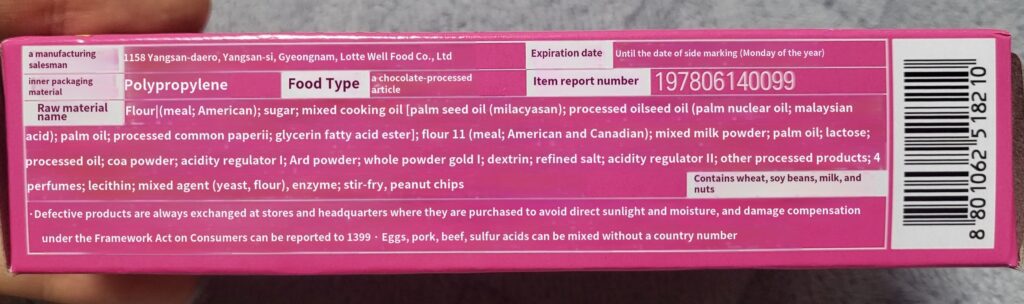
Nutrition Facts
- Total Weight: 54 g
- Total Calories: 265 kcal
| Nutrient | Amount | % Daily Value* |
| Sodium | 140 mg | 7 % |
| Total Carbohydrate | 36 g | 11 % |
| Total Sugars | 21 g | 21 % |
| Total Fat | 12 g | 22 % |
| Trans Fat | 0 g | – |
| Saturated Fat | 7 g | 47 % |
| Cholesterol | Less than 5 mg | 1 % |
| Protein | 3.5 g | 6 % |
Furthermore, Kancho holds a special place in the history of Korean pop culture because it once sparked an incredibly fun social trend. Years ago, Lotte Confectionery released a special edition where they replaced the usual illustrations with common Korean given names printed directly onto the biscuits. This triggered a massive phenomenon across schools and universities nationwide! Friends, classmates, and couples would buy boxes of Kancho, empty them onto tables, and spend hours laughing while searching for their own names, their friends’ names, or even the name of their secret crush among the sea of round cookies. The fact that a simple snack could bring people together to share laughter and create lasting memories shows how deeply Kancho is cherished as a familiar, comfort-inducing friend to the Korean people.
A Small but Certain Happiness for Just One Dollar
Finally, let us discuss the practical details that every savvy traveler loves to hear: the price point. You might assume that a snack with such deep cultural roots, beautiful packaging, and delicious flavor would come with a premium price tag, but Kancho is incredibly budget-friendly. When I walked into my local neighborhood supermarket just a few days ago, a standard box of Kancho cost me exactly 1,300 Korean Won! When you convert that amount into US dollars based on recent exchange rates, it translates to roughly between $0.95 and $1.00.
Yes, you read that absolutely right! For less than a single one-dollar bill, you can personally experience an authentic piece of Korean culinary culture. In South Korea, we have a very popular slang word, “So-hwak-haeng,” which beautifully translates to “a small but certain happiness found in daily life.” I truly believe that a box of Kancho, which costs just one dollar but brings immense joy to your taste buds and a smile to your face, is the absolute definition of this beautiful philosophy.
While luxury souvenirs and fancy dining experiences are wonderful, purchasing an inexpensive box of Kancho from a local mart allows you to connect deeply with the everyday lifestyle, history, and childhood nostalgia of real Korean people. If you ever have the wonderful opportunity to travel to South Korea, please make sure to explore the snack aisle and look for this signature pink box. As you admire the tiny illustrations on each biscuit and savor its light, balanced sweetness, you will realize that you are experiencing the true, authentic heart of local Korean culture!
